While at the "Wailing Wall" we heard a loud commotion as a large crowd approached from a distance. When we saw a teenage boy being carried on a man's shoulders in the crowd, we realized that we were witnessing a Bar Mitzvah. This is a "coming of age" party that is given for every Jewish boy when he gets to be 13 years old. It was quite an interesting an unusual experience!
Saturday, November 19, 2011

Friday, November 18, 2011
I Walked Today Where Jesus Walked- Part 2
The western wall is located at the foot of the western side of the Temple Mount. It is a remnant of the ancient wall that surrounded the Jewish Temple's courtyard and is one of the most sacred sites in Judaism, outside of the Temple Mount itself. Also known as the "Wailing Wall", it was constructed by Herod the Great and dates back to around 19 B.C. Many Jews come here to offer their prayers to God by placing small slips of paper between the cracks in the stones.


Jews Praying at the "Wailing Wall"

Western Wall of the Temple Mount or "Wailing Wall"
In the southwest corner of the Old City recent archeological excavations have uncovered remains dating back to Jesus' time. On the south side of the Temple Mount steps from the first century that Jews of that time would have used to enter the temple area can now be seen . Nearby, approximately 25 feet below the present street level, lies the main street of Jerusalem of 2000 years ago. This street would have spanned the entire length of the western wall of the temple and, once again, is one of only a few places in Jerusalem of today where we can be virtually certain that we have walked on the same exact streets as Jesus walked.

Steps to the Temple

1st Century Main Street
As you gaze at the Western Wall of the Temple Mount from street level you might notice that there are stones protruding from the wall at one particular spot. This is actually the remains of Robinson's Arch, named after the American archeologist who identified it. The arch supported a monumental stairway leading up to the Temple Mount plaza. These structures were built by King Herod between 37 and 4 B.C.

Robinson's Arch Today

Robinson's Arch in King Herod's Time
Possibly the most important archeological discovery of the last 100 years was the discovery of the "Dead Sea Scrolls" at Qumran in 1947. The scrolls that were found in caves by a shepherd boy contain some of the earliest known manuscripts of many Old Testament books. The Shrine of the Book Museum in Jerusalem contains many of the original manuscripts found at Qumran. Also, located behind the museum is a model of the city of Jerusalem in the time of Christ, This 1:50 scale model, which is also topographically correct, helps the visitor visualize all of the buildings of ancient Jerusalem in 3-D format.

Shrine of the Book

Model showing Fortress of Antonio

Model Showing City of David

Wyeth Luter, Robert Bluethman, Karen Bluethman, Wesley Brown,
Bart Huemmer & Sue Brooks View Jerusalem Model

Pool Of Bethesda Model

Model of the Temple
Wednesday, November 16, 2011
"I Walked Today Where Jesus Walked" -- Part 1
After Jesus was arrested in the Garden of Gethsemane, He was taken by Roman soldiers to the house of Caiaphas, the High Priest.He was imprisoned there for several hours, while awaiting His trial.It was also during this time that Peter denied the Lord three times. (Matthew 26:57-75)Today, the Church of St. Peter in Gallicantu (Cock Crow) stands at the probable site where Caiaphas' house was located.


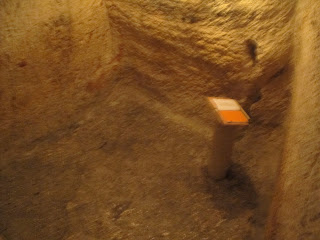


1st century steps used by Roman soldiers to take Jesus to Caiaphas' house

The Church of St. Peter in Gallicantu

Cistern under Caiaphas' house used to hold prisoners,
perhaps Jesus Himself

Bart Huemmer, Billie Sheppard, Wyeth Luter, Sue Brooks, Betty Scarbrough

Sue Brooks at guard station peering into the prison chamber below
while Billie Sheppard awaits her turn
Church historians refer to this as the Upper Room, where Jesus had his last meal with his disciples. Archaeologists know that it was built in the 12th century; however there is strong evidence that it was built over the site of the actual Upper Room.
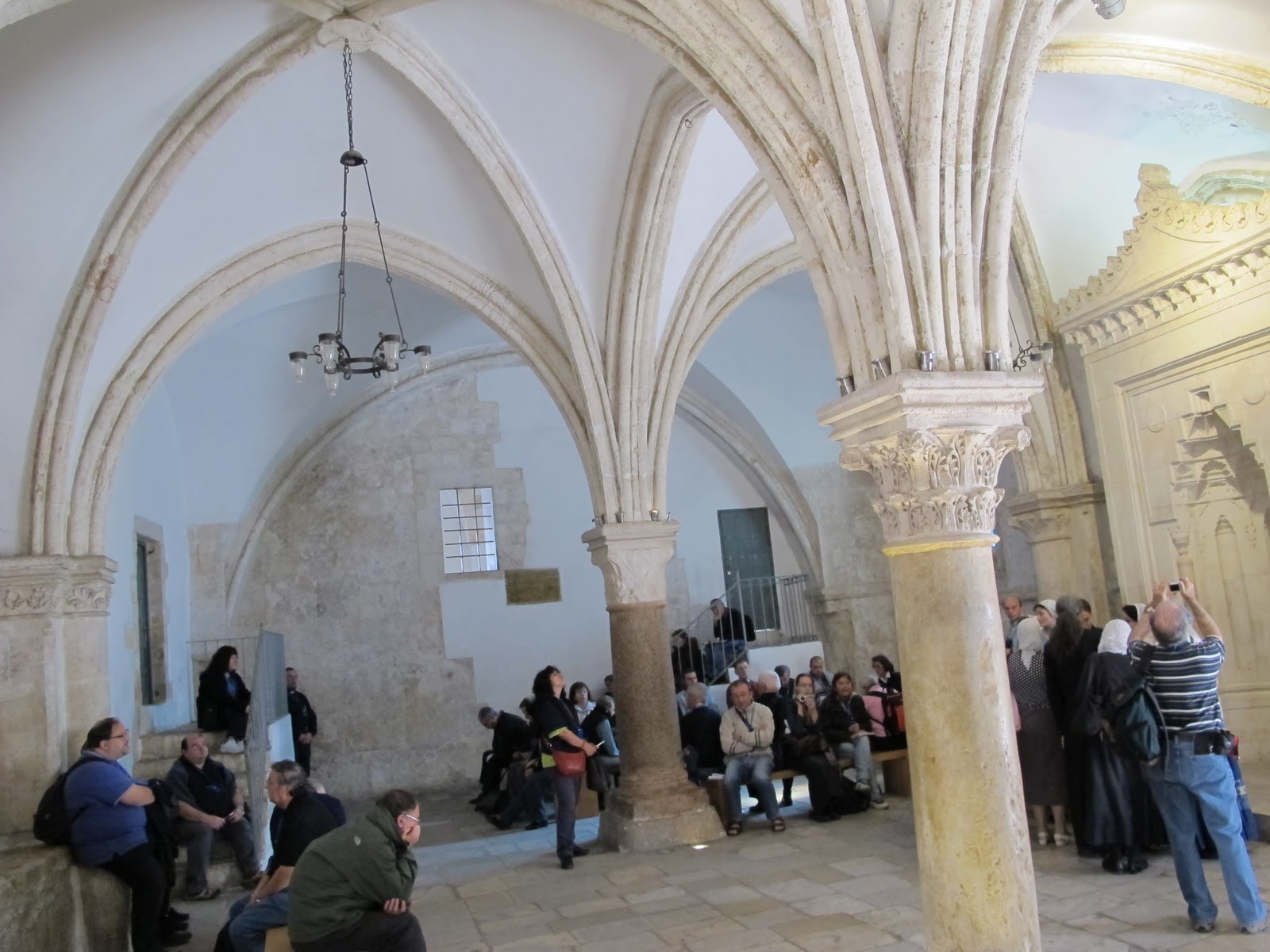
Upper Room
This is another of the relatively small number of sites in Israel where one can be virtually certain that he is walking where Jesus walked. These flagstones on the main street of Jerusalem were laid in the first century and have not been replaced. They were discovered and verified in 1986 and are among the most reliable pathways of Jesus.

Flagstones

Our guide, Nathan Shapiro, informs us of circumstances
surrounding the discovery of this 1st century street
To Be Continued...
Tuesday, November 15, 2011
Jerusalem in Pictures!
Another busy, yet wonderful and informative day of touring. Since we are all very tired, we thought we would just post a few pictures for you of sites in and around Jerusalem . Hopefully, tomorrow we will be able to give you more details about what we were privileged to see!

Camel on the Mt. of Olives

Jerusalem YMCA Building

King David Hotel

Walking Through the Old City

Shofar Horns

Workmen Repairing the Eastern Wall of the City

Bag Ladies- Sue Brooks, Betty Scarbrough & Wyeth Luter

Hotel Outside Damascus Gate

Orthodox Jewish Family

Our Group in the Old City

Bill Luter Waits To Buy Pomegranite Juice

Lion of Judah!

McIsrael

Damascus Gate

Camel on the Mt. of Olives

Jerusalem YMCA Building

King David Hotel

Walking Through the Old City

Shofar Horns

Workmen Repairing the Eastern Wall of the City

Bag Ladies- Sue Brooks, Betty Scarbrough & Wyeth Luter

Hotel Outside Damascus Gate

Orthodox Jewish Family

Our Group in the Old City

Bill Luter Waits To Buy Pomegranite Juice

Lion of Judah!

McIsrael

Damascus Gate
Monday, November 14, 2011
Jerusalem! Jerusalem!
We began our day on the top of the Mt. of Olives, one of the highest points in Jerusalem. Nearly 2000 years ago, Jesus stood on this hillside and delivered some of His most important teachings and prophecies. From this vantage point, one has a spectacular view of the Old City of Jerusalem, including the Temple Mount, the Pinnacle, the Golden Gate (Eastern Gate), and the City of David. The western slope is covered by more than 150,000 Jewish graves, all made of stone. Our group was able to find a quiet spot for a short service, including scripture reading by Ken , prayer, and singing of the hymn, "In the Garden." It was a very meaningful time and one of the highlights of the trip thus far.

View of Jerusalem from Mount of Olives

Pinnacle of the Temple

Jewish Cemetery on Mount of Olives

Back Row: Ron Scarbrough, Sue Brooks, Ken Sheppard, Billie Sheppard, Bart Huemmer,
Karen Bluethman, Robert Bluethman, Charles Fortune
Front Row: Betty Scarbrough, Eddie Brown, Wesley Brown, Margie Huemmer, Wyeth Luter,
Bill Luter, Gary Purdy
From the top of the Mt. of Olives, we walked down the winding path where Jesus rode on a donkey into Jerusalem on Palm Sunday.


At the foot of the Mt. of Olives lies the Garden of Gethsemane, where Jesus spent his final hours before being arrested by Roman soldiers. Near the Garden stands a beautiful church called the Church of All Nations. Inside the church is a large rock called the "Rock of Agony" where Jesus, " being in agony He prayed more earnestly and His sweat became like great drops of blood falling down to the ground." (Luke 22:44)


Garden of Gethsemane

Church of All Nations

Rock of Agony
Having toured steadily for a full week, we enjoyed an afternoon of leisure time. Bezalel Ben Yehuda is a quaint pedestrian street lined with interesting shops and restaurants. For lunch, some of us tried the local cuisine of shawarma (roasted lamb) and sweet potato soup, while others preferred the traditional Jewish bagels and cream cheese. Of course, there was room for ice cream for dessert!

Bezalel Ben Yehuda Street

Charles Fortune eating shawarma

Wyeth Luter, Bill Luter, Eddie Brown, Charles Fortune, Wesley Brown, Betty Scarbrough

Ron Scarbrough, Bill Luter
Sunday, November 13, 2011
"This is My beloved Son in Whom I am well pleased."
Departing the Sea of Galilee, we came to the baptismal site where millions of people have come to be baptized in the Jordan River. Although this is not considered to be the place where Jesus was baptized by John the Baptist, that place would be similar in appearance to this site and we can now better visualize that important event in Jesus' life. One cannot help being gripped by the diversity of the universal church at this site. There were disciples present from "every nation, tribe, people and language", drawn together in this one place by a common faith in Jesus Christ.


Believers preparing to be baptized

Muskrats!
As we entered the town named Bet She'an, little did we realize we were about to explore the largest archaeological dig in the world. The Bet She'an National Park extends to over 400 acres, a larger area than the Roman Forum or the ruins of Ephesus; twenty-seven layers of civilization have been uncovered. In I Samuel 31, we read that King Saul and his son Jonathan were killed on nearby Mt. Gilboa during a battle against the Philistine army. The Philistines then displayed the bodies of Saul and his sons on the Bet She'an city walls. The city was later taken by King David, along with Megiddo and Ta'anach, becoming an administrative center of the region during King Solomon's reign. About one-tenth of the Roman city's area has been uncovered today, including an amphitheatre, elaborate bath house, shopping mall, public lavatories, and a colonnaded street.


The Zodiac mosaic floor in the 6th century Synagogue at Bet Alfa.

Let me remind you of this great story. Gideon, one of the judges, was facing the Midianite army. In order to demonstrate His power in the battle, the Lord reduced Gideon's force from 32,000 to 10,000. He then used a test at this spring, the Spring of Harod, to further reduce Gideon's men from 10,000 to 300. The 300 were those who were vigilant as they drank from the water. Read Judges 7 to find out how this unusual victory took place.

Spring of Harod (Gideon's Spring)

Then we had lunch at Burger Ranch, an Israeli version of a typical American fast food restaurant chain. Service was pleasant, food was good, expectations met (except for ice and ketchup). Check out Burger Ranch at www.burgeranch.co.il.

Betty Scarbrough, Wyeth Luter, Wesley Brown, Billie Sheppard

Full Meal Burger Ranch Deal

Mary Beard

Ken & Billie Sheppard, Eddie & Wesley Brown
We continued our travels south on the "road of the valley" just west of the Jordan River. This would be the route that Jesus and His family would have walked when going from Nazareth to Jerusalem to attend Jewish festivals and Holy days. Below are some of the sites we saw along the way.

Mount of Temptation

Border with Jordan

Date Palms Growing Beside the Jordan River

Camels

Goats & Sheep

City of Jericho in the distance

Bedouin Camp
Subscribe to:
Posts (Atom)